
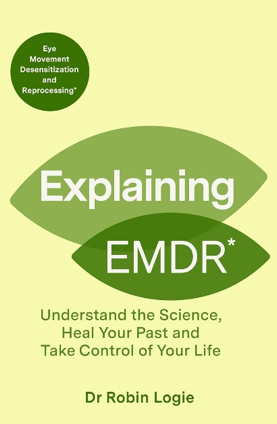
‘Explaining EMDR’ by Robin Logie
Published by August Books (subsidiary of Penguin Random House)
What the official blurb says:
The accessible, expert-led guide to understanding how this revolutionary therapy could help you.
EMDR (Eye Movement Desensitisation and Reprocessing) Therapy is a revolutionary therapy which helps people efficiently process and recover from past experiences that are impacting on their mental health and wellbeing.
Explaining EMDR will help you understand what EMDR is and how it works to treat a myriad of conditions including PTSD, anxiety and depression. Using real-life stories from patients who have found EMDR beneficial it will help you consider whether EMDR would be useful for you or your family and will offer guidance on how to find a qualified practitioner.
Written in accessible prose by Dr Robin Logie, Explaining EMDR is a worthwhile read for anyone looking at new ways to improve their mental health, tackle specific conditions or find the right therapist for them.
Order from: Psychological Therapy Books, independent bookseller, cheaper and more ethical than Amazon:
WHAT’S IN THE BOOK
Chapter 1: What is EMDR?
This chapter explains EMDR (Eye Movement Desensitisation and Reprocessing) as a powerful therapy for trauma and anxiety that helps the brain process distressing memories that have become “stuck.”
Robin describes moving from scepticism to belief in EMDR after experiencing its effects personally and seeing positive results with his clients.
Using eye movements while recalling traumatic memories, EMDR helps people reduce emotional distress, change negative beliefs about themselves, and feel that painful events truly belong in the past.
Chapter 2: How was EMDR discovered?
This chapter explains how EMDR was discovered by psychologist Francine Shapiro in 1987 after she noticed that moving her eyes side to side reduced the emotional impact of distressing thoughts.
She developed this observation into a therapy for trauma, first called EMD and later renamed EMDR because it not only reduced distress but also helped people reprocess painful experiences and change negative beliefs about themselves. EMDR was soon used successfully with people suffering from PTSD, including war veterans and survivors of abuse or assault, and research showing its effectiveness helped it gain worldwide recognition.
What was once seen as a strange fringe therapy is now widely accepted, recommended by organisations such as World Health Organization and used internationally to treat trauma and other mental health difficulties.
Chapter 3: Psychological trauma
This chapter explores psychological trauma, explaining that trauma occurs when overwhelming experiences cannot be fully processed by the brain, leaving people stuck and reliving the event through flashbacks, anxiety, avoidance, or emotional distress.
It highlights that both major events, such as violence or accidents, and long-term emotional neglect can deeply affect mental health and shape beliefs about safety and self-worth.
The chapter also explains how the brain responds to danger, the role of attachment styles developed in childhood, and how early relationships influence resilience and coping.
EMDR is presented as a way of helping the brain restart its natural “adaptive information processing” so traumatic experiences can finally become processed memories rather than ongoing emotional experiences.
Chapter 4: What happens in an EMDR session?
This chapter explains how EMDR therapy helps people process traumatic memories so they no longer feel trapped in the present. Through personal accounts and detailed explanation, it describes the eight phases of an EMDR session, from sharing life experiences and preparing for therapy, to activating traumatic memories, processing them through bilateral stimulation such as eye movements, strengthening healthier beliefs, and reviewing progress over time.
The chapter emphasises the importance of safety, trust, attachment, and emotional regulation within the therapeutic relationship, showing how EMDR can transform trauma from something overwhelming and immediate into something remembered but no longer emotionally consuming.
Chapter 5: What can EMDR do … and what can’t it do?
Chapter 5 explores what EMDR can and cannot treat, explaining that while it was originally developed for PTSD, it can also help with many other psychological difficulties such as depression, OCD, psychosis, anxiety, and phobias.
The chapter argues that mental health problems arise from a combination of “nature and nurture,” with trauma and life experiences often shaping how symptoms develop. Rather than focusing only on diagnoses through the “medical model,” the author emphasises understanding “what has happened to you” and how unresolved experiences become stuck in the nervous system according to EMDR’s Adaptive Information Processing (AIP) model.
Through case examples, the chapter shows how EMDR can process painful memories underlying negative beliefs and emotional distress. However, EMDR cannot change neurodiversity such as autism or ADHD, nor can it remove normal grief or help while someone is still in ongoing danger; instead, it can address the trauma associated with these experiences. The chapter concludes by highlighting the strong scientific evidence supporting EMDR, particularly for PTSD, and its growing use for many other psychological conditions.
Chapter 6: Can EMDR help my child?
This chapter explains how EMDR therapy can be highly effective for children and adolescents, often helping them recover from trauma, anxiety, phobias, OCD, behavioural difficulties, and attachment-related problems more quickly than some other therapies.
The chapter highlights that therapy involves not only the child but also parents, caregivers, and sometimes schools, with therapists adapting EMDR techniques to suit a child’s age, understanding, and emotional needs. It describes how storytelling, play, and child-friendly approaches can help children process difficult experiences, especially when they struggle to express emotions directly.
Through fictional examples, the chapter shows how EMDR can help children overcome trauma, fear, anger, and insecurity, particularly when combined with supportive therapies such as CBT or attachment-focused approaches.
It also emphasises that EMDR can be adapted for online sessions and neurodivergent children, and concludes by noting that research strongly supports EMDR as an effective treatment for childhood PTSD and other emotional difficulties.
Chapter 7: How can I get EMDR?
The chapter explains how to safely access and use EMDR therapy. It emphasizes the importance of choosing an accredited and properly trained EMDR therapist, as the growing popularity of EMDR has led to unregulated courses, unqualified practitioners, and unreliable self-help apps and books.
The chapter discusses how online EMDR became widely accepted after COVID-19 and can be effective when delivered by a trained therapist, though it has practical and technological challenges. It strongly cautions against self-administered EMDR processing without professional support, as this can lead to emotional overwhelm or re-traumatisation, while acknowledging that some carefully designed self-help resources may help with preparation, relaxation, and symptom management.
The chapter also outlines what is required to train as an EMDR therapist. It describes safe self-help exercises for understanding personal trauma patterns and strengthening emotional resources. It concludes by highlighting EMDR’s potential to support recovery, healing, and personal transformation.